Found the cause: greenhouse-controller's firmware channel changed from stable to nightly at 01:48 UTC, 12 minutes before greenhouse-controller first failed
Put greenhouse-controller back to stable, its last good setting
greenhouse-controller is back on its last good setting
greenhouse-controller · firmware channel
stable
Asked
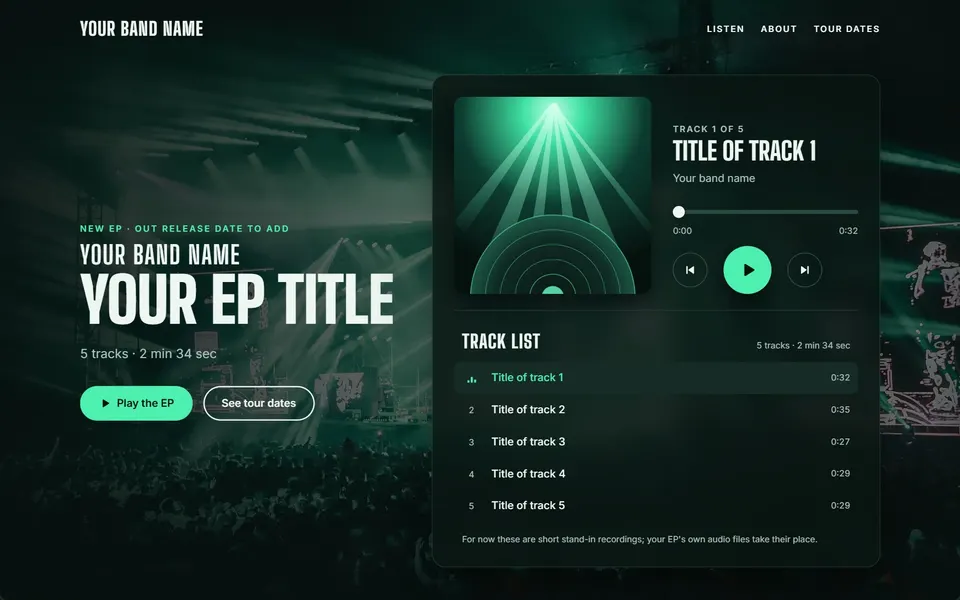
“A music player page for a band's new EP with track list, play and pause, a progress bar and tour dates”
Found it: port 1 was shut by the switch’s own loop protection, a second cable closing a loop
Said which cable to pull, then turned the port back on the moment the loop was gone
The link is back up and the router answers again
Port 1 – the link to the router
Shut → Back on
Asked
“Look over this firewall’s set-up”
Read its whole set-up through its own sign-in, changing nothing
Found 3 things to tighten
Tightened 1 thing and read each change back
Safer than it was, each change read back
Xovris checks your address, HTTPS answer, certificate and pages from outside, the way a visitor reaches you, and tells you in plain words what changed and what to do.
xovris.ai answers from 6 of the places Xovris askedRead 18 November 2026 23:05:29 UTC
Germany328 ms
United States365 ms
Brazil245 ms
Japan124 ms
Australia195 ms
South Africa95 ms
Answering from everywhere Xovris checks
Answered first95 ms
Slowest365 ms
XovrisOn its own
xovris.ai, asked from every location Xovris uses
6 of 6 answered
Slowest: United States, 365 ms
Checks again on a schedule from the same places
Technical detail
Germany, DE50.48, 12.37328 ms
United States, US42.89, -78.88365 ms
Brazil, BR-23.55, -46.64245 ms
Japan, JP35.69, 139.69124 ms
Australia, AU-33.77, 150.9195 ms
South Africa, ZA-26.2, 28.0495 ms
Xovris’s check of xovris.ai from several places
01
What Xovris readon its own domain.
xovris.ai is served from Cloudflare, Inc., keeps its DNS on Cloudflare and keeps its email on Microsoft 365. Everything Xovris could read on xovris.ai answers as it should – none of 11 readings is wrong.
Websites on xovris.ai23:05:28 UTC
Address
Fine
Browsers can find it.
Secure connection (HTTPS)
Fine
Answered your browser over HTTPS in 74 ms.
Page from outside
Fine
Answered Xovris’s probe with 200 in 98 ms.
Certificate
Fine
Valid until 31 December 2026 – 42 days left.
Registration
Fine
Registered until 1 October 2028.
XovrisOn its own
What Xovris sees on a domain, line by line.
The values behind each answer, exactly as they were recorded.
What a fix gives you: what broke, what changed and that it works again.
Enter your website address. There is nothing to install and no account to connect.
What Xovris watches
The address answers – browsers can find you
The HTTPS answer and how long it took
The certificate: valid, trusted and when it expires
The page as a visitor gets it, with every redirect
The domain’s registration and expiry date
What Xovris puts right
A site that went offline brought back – its address, its certificate or its host put right, or your visitors sent to your standby while a provider is down and back once it recovers – with its way back ready first
What waits for your permission
Your site’s code (always as a pull request you review), content and hosting settings
03
Try it now,on your own.
Each of these runs in your own browser in seconds. Here is what each says for xovris.ai, checked 18 November 2026, 23:05:28 UTC – open one to run it on yours.
One bar on every open incident: fix it, show me first, call me or handle it
Every open incident ends with the four choices a person actually makes – let Xovris fix it, see the fix first, be called, or have Xovris handle it from now on – the same from the app, the alert email or Slack.
What was wrong, how it was found, what changed and the before and after side by side – plain words first, the technical line under each, built only from the incident’s own records.
Every incident has a live tracker, like a parcel delivery
Detected, cause found, fix ready, approved, applied, verified – each step appears when its record exists, with its time, so you always know where a problem stands.
Your own failing outcome is reproduced before anything changes and run again after the fix, with the checks around it, and re-checked later; a fix that does not pass is put back and the next approach starts, and you pay nothing for it until the after-test passes.
A fix counts only when your own journey works again, and one that does not is put back
After a repair your own journey is run again – the site’s address with the status and words it must answer, or the check that first failed – and only that pass marks the incident fixed and verified.
A change that touches several places goes to one first, is checked against your own uptime and error rates, and is put back automatically if anything gets worse – the other places are never touched.
This is the same check Xovris keeps running once you keep watching. It runs in your browser now, and nothing is saved to an account.
Check yours
Read here, in your own browser. Xovris keeps nothing of it.
Questions
Does Xovris need access to my accounts to watch?
No. Watching needs nothing beyond what anyone on the internet can see. When you want Xovris to fix things, you grant access scope by scope, for as many zones and projects as you choose.
What does the free plan include?
Watching and alerts, free for good. Personal adds fixing: Xovris puts problems right, and an issue counts only once it works again.
Can I undo a fix?
Yes. Every fix has its undo written down before it runs, and a fix that fails its after-test is undone automatically.
Is my data used to train AI?
No. Your data is never used to train our AI. Your systems, files, logs and settings stay yours: they are never used to train any AI, ours or anyone else’s, and nothing of yours ever reaches another customer.
Words on this page, in plain English
Each technical word this page uses, said simply.
Plain-text data (JSON)
A common way of writing data as named values, readable by people and programs alike.
Data an app reports about itself (telemetry)
The errors, timings and records an app sends out so problems can be spotted and explained.
Domain Name System (DNS)
The internet’s address book: it turns a name you type into the number of the computer that answers for it.
 At 00:31:03 UTC
 At 00:31:20 UTC